Low Dose Semaglutide for Weight Loss: What the Trials Show, Dose by Dose
Low dose semaglutide for weight loss is not a guess. Several trials ran the drug at doses far below 2.4 mg, and their numbers show where the weight loss starts, where the side effects climb, and where the evidence simply stops.
6.0%
WEIGHT LOSS AT 52 WEEKS ON THE SMALLEST DAILY DOSE TESTED, 0.05 MG (LANCET 2018)
0.25 mg
THE WEEKLY STARTING DOSE ON THE WEGOVY LABEL, HELD FOR WEEKS 1 TO 4
1.7 mg
THE LOWEST MAINTENANCE DOSE THE LABEL LISTS FOR WEIGHT REDUCTION IN ADULTS
Most people searching for low dose semaglutide want one of two things. Some want to know whether a smaller dose still does anything. Others started the full schedule, hit a wall of nausea at the second or third step, and want to know if staying lower is a real option or just giving up.
Both questions have better answers than the internet usually gives. Semaglutide was tested at doses as small as 0.05 mg a day before the weight-loss dose was chosen, and the diabetes trials ran 0.5 mg and 1.0 mg weekly for months. This article walks through those results dose by dose, then covers hair loss, maintenance, and what stopping does. It also marks the point where the trial data run out, because that point is lower than most people assume.
Key takeaways
- •In a 2018 Lancet dose-ranging trial of 957 adults without diabetes, daily semaglutide at 0.05 mg produced 6.0% weight loss at 52 weeks versus 2.3% on placebo, and 0.4 mg produced 13.8%.
- •In SUSTAIN 1, adults with type 2 diabetes lost 3.73 kg on semaglutide 0.5 mg weekly and 4.53 kg on 1.0 mg over 30 weeks, against 0.98 kg on placebo.
- •Digestive side effects scale with dose: in STEP 2, gastrointestinal events affected 57.5% on 1.0 mg, 63.5% on 2.4 mg and 34.3% on placebo.
- •The Wegovy label starts at 0.25 mg weekly and lists 1.7 mg or 2.4 mg as maintenance doses for weight reduction in adults.
- •No trial has tested weekly semaglutide below the 0.25 mg starting dose for weight loss, so microdosing results remain unmeasured.
Is there a low dose semaglutide for weight loss?
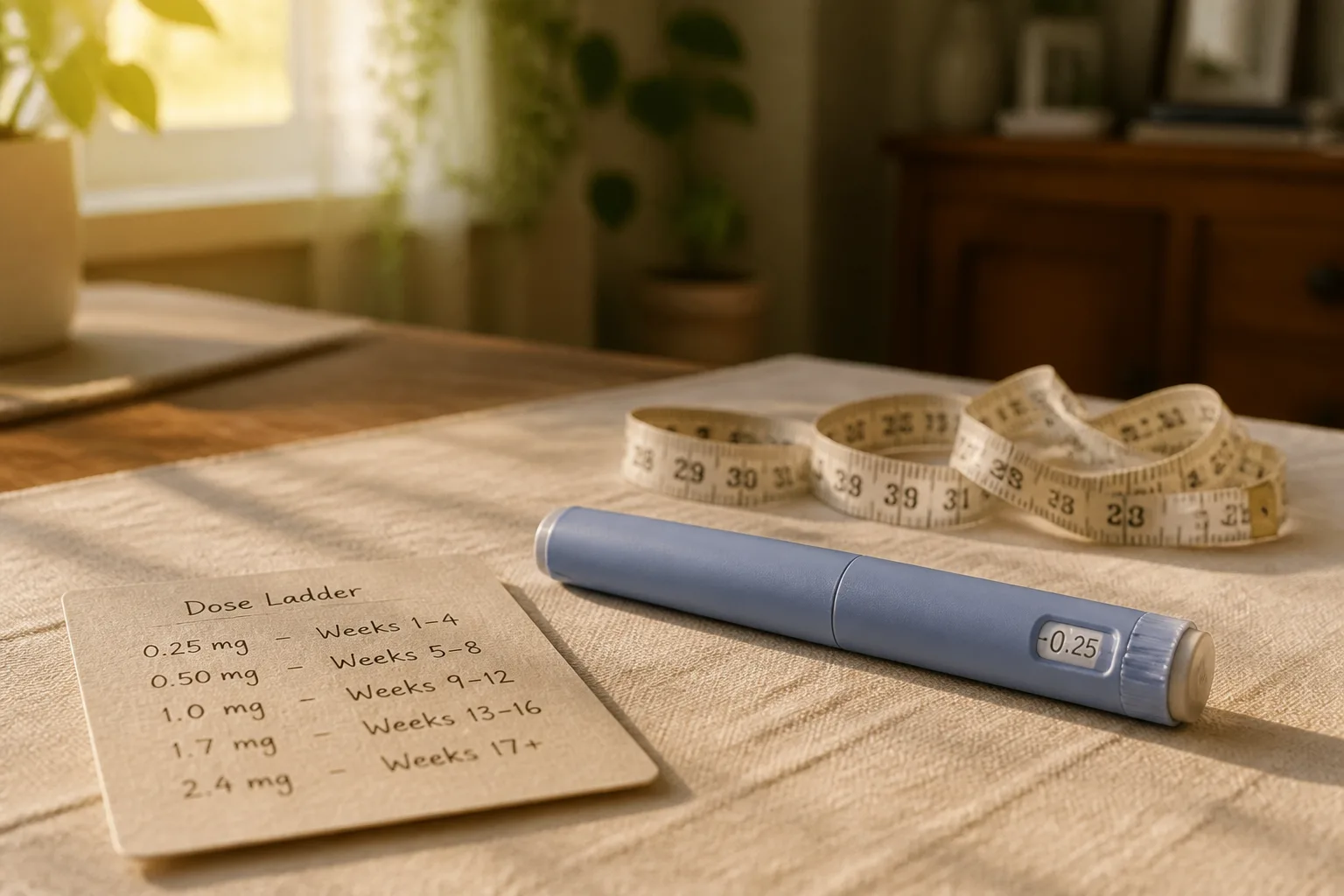
Low dose semaglutide is built into the approved schedule itself. The Wegovy prescribing information starts every adult at 0.25 mg once weekly for weeks 1 through 4, then raises the dose to 0.5 mg, 1 mg and 1.7 mg in 4-week steps. From week 17 the person reaches a maintenance dose.
Wegovy injection dose escalation (weekly dose, mg)
WEGOVY prescribing information, DailyMed, Table 1. Week 17 on shows the recommended 2.4 mg; 1.7 mg is the alternative maintenance dose.
The label says the slow climb is there to reduce the risk of gastrointestinal adverse reactions.
The label offers two maintenance doses for weight reduction in adults: 1.7 mg or 2.4 mg, with 2.4 mg recommended. It asks prescribers to consider treatment response and tolerability when choosing between them. If a person cannot tolerate a step, the label suggests delaying the next increase by 4 weeks. The current label also allows a further increase to a maximum of 7.2 mg for people who tolerate 2.4 mg and need more weight reduction.
So the honest answer to "is there a low dose" is yes, in two senses. The early rungs are low doses that everyone passes through, and 1.7 mg is an approved lower maintenance option. What the label does not include is any weekly dose below 0.25 mg.
Does a low dose of semaglutide work?
A low dose of semaglutide does work, in the sense that it produces weight loss well beyond placebo. The clearest evidence comes from the phase 2 trial by O'Neil and colleagues, published in the Lancet in 2018. It randomized 957 adults without diabetes, with a mean starting weight of 111.5 kg and a mean BMI of 39.3, to one of five daily semaglutide doses, liraglutide 3.0 mg or placebo for 52 weeks.
Mean weight loss at week 52 by daily semaglutide dose (%)
O'Neil PM et al., Lancet 2018 (957 adults without diabetes, once-daily injections).
The curve rises steeply at first, then flattens: 0.3 mg/day did slightly worse than 0.2 mg/day.
Placebo produced 2.3% weight loss. The smallest semaglutide dose, 0.05 mg a day, produced 6.0%. Then came 8.6% at 0.1 mg, 11.6% at 0.2 mg, 11.2% at 0.3 mg and 13.8% at 0.4 mg. Liraglutide 3.0 mg, an older daily GLP-1 drug, reached 7.8%. Losing 10% or more of body weight happened in 10% of the placebo group and in 37-65% of people on 0.1 mg of semaglutide or more.
Two lessons sit in that chart. The first is that the dose-response curve starts early: the smallest dose already beat placebo clearly. The second is that it is not a straight line, so doubling a dose does not double the result. Both points matter for anyone weighing a lower dose, and both come with a caveat covered further down: these were daily injections.
How much weight do people lose on 0.5 mg or 1 mg weekly?
People on 0.5 mg or 1 mg of weekly semaglutide lose a modest but real amount of weight, at least in the diabetes trials where those doses were studied. The SUSTAIN 1 trial by Sorli and colleagues, published in Lancet Diabetes & Endocrinology in 2017, gave 387 adults with type 2 diabetes either semaglutide 0.5 mg, 1.0 mg or placebo once weekly for 30 weeks.
Weight lost (kg) and nausea (% of patients) at week 30, SUSTAIN 1
Sorli C et al., Lancet Diabetes Endocrinol 2017 (adults with type 2 diabetes, mean starting weight 91.93 kg).
- Weight lost (kg)
- Nausea (% of patients)
The two bars use different units. Going from 0.5 mg to 1.0 mg added under a kilogram of weight loss and a few points of nausea.
Weight fell 3.73 kg on 0.5 mg and 4.53 kg on 1.0 mg, compared with 0.98 kg on placebo, from a mean starting weight of 91.93 kg. Blood sugar responded strongly at both doses, with HbA1c falling 1.45% and 1.55%. Nausea was reported by 20% on 0.5 mg, 24% on 1.0 mg and 8% on placebo.
These numbers come from people with type 2 diabetes over 30 weeks, and diabetes changes the picture. At the same 2.4 mg dose, people with diabetes in STEP 2 lost 9.6% of body weight, while people without diabetes in STEP 1 lost 14.9%. They should not be read as what 0.5 mg would do for someone without diabetes over a year. They do show that the step from 0.5 mg to 1.0 mg bought relatively little extra weight loss in this group.
Is low dose semaglutide safe for weight loss?
Low dose semaglutide carries fewer digestive side effects than higher doses, but it is not a different drug, and the label's warnings apply at every dose. The STEP 2 trial by Davies and colleagues, published in the Lancet in 2021, offers a direct comparison. It randomized 1210 adults with overweight or obesity and type 2 diabetes to semaglutide 2.4 mg, 1.0 mg or placebo for 68 weeks.
Gastrointestinal adverse events over 68 weeks (% of patients)
Davies M et al., Lancet 2021 (STEP 2, adults with overweight or obesity and type 2 diabetes).
Most events were mild to moderate. A third of the placebo group also reported digestive symptoms.
Gastrointestinal events were reported by 34.3% on placebo, 57.5% on 1.0 mg and 63.5% on 2.4 mg. The 2.4 mg dose produced 9.6% weight loss against 3.4% on placebo. The pattern fits the phase 2 finding that semaglutide's most common adverse events were "dose-related gastrointestinal symptoms, primarily nausea."
A lower dose softens that curve. It does not remove the label's boxed thyroid warning, the contraindications, or the cautions about the pancreas and gallbladder. Our article on whether microdosing Ozempic is safe covers those warnings and the dosing errors that poison centers have reported with compounded vials.
Does low dose semaglutide cause hair loss?
Hair loss on semaglutide appears to rise with dose and with the amount of weight lost, so a lower dose would be expected to carry less of it, though no trial has measured low doses directly. The Wegovy prescribing information states that hair loss reactions in treated patients "were associated with weight reduction."
Hair loss reported in the Wegovy 7.2 mg trials (% of patients)
WEGOVY prescribing information, DailyMed, section 6.1.
Rates were far higher in women than men in every arm of these trials.
In the trials of the newer 7.2 mg dose, hair loss was reported by 1.0% on placebo, 3.3% on 2.4 mg and 5.8% on 7.2 mg. In the earlier pooled weight-loss studies, it was 3.3% on 2.4 mg (4% of women, 0.9% of men) against 1% on placebo. The label gives no figure for any dose below 2.4 mg in weight-loss trials.
The link to weight reduction points to shedding driven by the weight loss itself rather than a direct effect on the hair follicle, but that mechanism has not been proven for semaglutide. Our guide to hair shedding during GLP-1 weight loss explains the timeline and what tends to help.
Is microdosing semaglutide effective for weight loss?
Microdosing semaglutide has not been tested for weight loss in any clinical trial, so its effectiveness is unknown. The term usually means weekly doses below the 0.25 mg starting rung, and the label stops at that rung. Every result above comes from doses inside the labeled schedule or from the daily-dosing phase 2 trial.
That phase 2 trial is often quoted as proof that tiny doses work. It does not quite say that. Its smallest arm took 0.05 mg every day, and seven of those doses add up to more semaglutide per week than the 0.25 mg weekly starting dose. A schedule of 0.1 mg once a week, for example, sits well below anything in that trial.
What the evidence supports is narrower and still useful: semaglutide's effect begins at low exposures, side effects rise with dose, and the curve flattens at the top. Whether a sub-label weekly dose lands on the useful part of that curve for a given person has not been measured. The complete guide to GLP-1 microdosing lays out how these protocols are usually framed and what to ask a prescriber.
Can a low dose keep weight off once it is lost?
Continuing semaglutide keeps weight off far better than stopping, but the trials that show this used the full 2.4 mg dose, not a lower one. The STEP 4 trial by Rubino and colleagues, published in JAMA in 2021, gave 902 adults a 20-week run-in on semaglutide, during which they lost a mean 10.6%. The 803 who reached 2.4 mg were then randomized to keep going or switch to placebo for 48 weeks.
Body weight change from week 20 to week 68 (%)
Rubino D et al., JAMA 2021 (STEP 4, 803 randomized adults without diabetes).
Negative values are further loss; positive values are regain.
People who kept taking semaglutide lost a further 7.9%, while those switched to placebo regained 6.9%. The STEP 1 extension, by Wilding and colleagues in 2022, followed 327 people for a year after all treatment stopped at week 68. Those who had taken semaglutide had lost 17.3%, and a year later they had regained 11.6 percentage points, leaving a net loss of 5.6%.
No published trial has tested stepping down to a lower semaglutide dose for maintenance, so "low dose semaglutide for weight maintenance" remains a reasonable question rather than an established practice. The label's 1.7 mg maintenance option is the only reduced dose with regulatory backing. When progress slows instead, our article on why GLP-1 weight loss stalls covers the usual causes.
What is the bottom line on low dose semaglutide?
Low dose semaglutide works, just less, and with fewer side effects. The trials show weight loss beginning at the smallest doses tested, a curve that flattens near the top, and nausea that climbs with every step. The approved schedule already includes low rungs and a lower 1.7 mg maintenance dose. Below 0.25 mg a week, the trial evidence ends, and anyone going there is working from extrapolation, not data. For someone who stalled on side effects, the practical move is to ask a prescriber about holding a step longer or settling at a lower labeled dose, rather than inventing a dose at home.
The dose-response curve for semaglutide starts low and bends early. The question is where on it a person can stay.
Frequently asked questions
Does low dose semaglutide work for weight loss?
Low dose semaglutide does produce weight loss in trials, though less than full doses. In a 2018 Lancet dose-ranging trial, the smallest daily dose of 0.05 mg led to 6.0% weight loss at 52 weeks compared with 2.3% on placebo. In SUSTAIN 1, adults with type 2 diabetes lost 3.73 kg on 0.5 mg weekly and 4.53 kg on 1.0 mg weekly over 30 weeks.
What is the lowest dose of semaglutide for weight loss?
The lowest dose on the Wegovy label is 0.25 mg once weekly, used for the first 4 weeks as a starting dose. The label then steps up every 4 weeks through 0.5 mg, 1 mg and 1.7 mg. The lowest maintenance dose the label lists for weight reduction in adults is 1.7 mg once weekly, with 2.4 mg recommended.
Is there a low dose semaglutide option?
Low doses of semaglutide exist as the starting steps of the approved schedule, beginning at 0.25 mg once weekly. The Wegovy label also allows 1.7 mg instead of 2.4 mg as a maintenance dose for weight reduction, based on response and tolerability. Doses below the labeled schedule are off-label and have not been tested for weight loss in trials.
Is low dose semaglutide safe for weight loss?
Low dose semaglutide tends to cause fewer digestive side effects than higher doses, but the label warnings apply at every dose. In SUSTAIN 1, nausea affected 20% of people on 0.5 mg, 24% on 1.0 mg and 8% on placebo. Safety at doses below the labeled starting dose has not been studied, so dose choices belong with a prescriber.
Does low dose semaglutide cause hair loss?
Hair loss on semaglutide appears to track weight loss and dose rather than appearing at a fixed threshold. The Wegovy label reports hair loss in 1.0% on placebo, 3.3% on 2.4 mg and 5.8% on 7.2 mg in its higher-dose trials, and says the reactions were associated with weight reduction. No trial has reported hair loss rates for doses below 2.4 mg in weight-loss studies.
Is microdosing semaglutide effective for weight loss?
Microdosing semaglutide has not been tested in a clinical trial, so its effectiveness is not established. The closest data come from a phase 2 trial that gave daily doses as small as 0.05 mg and still saw 6.0% weight loss at 52 weeks. Seven of those daily doses add up to more than the 0.25 mg weekly starting dose, so the result cannot be carried over to smaller weekly microdoses.
Can low dose semaglutide be used for weight maintenance?
Low dose semaglutide for weight maintenance has not been tested directly. The STEP 4 trial showed that people who kept taking 2.4 mg after a 20-week run-in lost a further 7.9%, while those switched to placebo regained 6.9%. Whether a reduced dose holds weight as well as the full dose is still an open research question.
What happens to weight after stopping semaglutide?
Most lost weight tends to return after stopping semaglutide, at least after full-dose treatment. In the STEP 1 extension of 327 people, those who had taken semaglutide had lost 17.3% by week 68 and regained 11.6 percentage points within a year of stopping, leaving a net loss of 5.6%. That is roughly two-thirds of the lost weight coming back.
Clinical references
- O'Neil PM, Birkenfeld AL, McGowan B, et al. Efficacy and safety of semaglutide compared with liraglutide and placebo for weight loss in patients with obesity: a randomised, double-blind, placebo and active controlled, dose-ranging, phase 2 trial. Lancet. 2018. doi:10.1016/S0140-6736(18)31773-2
- Sorli C, Harashima SI, Tsoukas GM, et al. Efficacy and safety of once-weekly semaglutide monotherapy versus placebo in patients with type 2 diabetes (SUSTAIN 1). Lancet Diabetes & Endocrinology. 2017. doi:10.1016/S2213-8587(17)30013-X
- Davies M, Færch L, Jeppesen OK, et al. Semaglutide 2.4 mg once a week in adults with overweight or obesity, and type 2 diabetes (STEP 2). Lancet. 2021. doi:10.1016/S0140-6736(21)00213-0
- Wilding JPH, Batterham RL, Calanna S, et al. Once-weekly semaglutide in adults with overweight or obesity (STEP 1). New England Journal of Medicine. 2021. doi:10.1056/NEJMoa2032183
- Rubino D, Abrahamsson N, Davies M, et al. Effect of continued weekly subcutaneous semaglutide vs placebo on weight loss maintenance in adults with overweight or obesity: the STEP 4 randomized clinical trial. JAMA. 2021. doi:10.1001/jama.2021.3224
- Wilding JPH, Batterham RL, Davies M, et al. Weight regain and cardiometabolic effects after withdrawal of semaglutide: the STEP 1 trial extension. Diabetes, Obesity and Metabolism. 2022. doi:10.1111/dom.14725
- WEGOVY (semaglutide) injection and tablets, prescribing information. DailyMed, National Library of Medicine. Accessed October 11, 2026. dailymed.nlm.nih.gov
Medical disclaimer. This article is for general educational and informational purposes only. It is not medical advice and not a substitute for the physician, prescriber, pharmacist, or clinician responsible for your care. Semaglutide is a prescription medicine, and taking it below the labeled schedule is off-label use that has not been tested in clinical trials. Charts show values reported in the cited studies and prescribing information; results from people with type 2 diabetes may not apply to people without it. Do not change, split, or share a dose without your prescriber. Severe or persistent abdominal pain, repeated vomiting, signs of dehydration, or a lump in the neck need prompt medical attention.