Birth Control on a GLP-1 Microdose: Why Tirzepatide Can Weaken the Pill and What the Label Says to Do
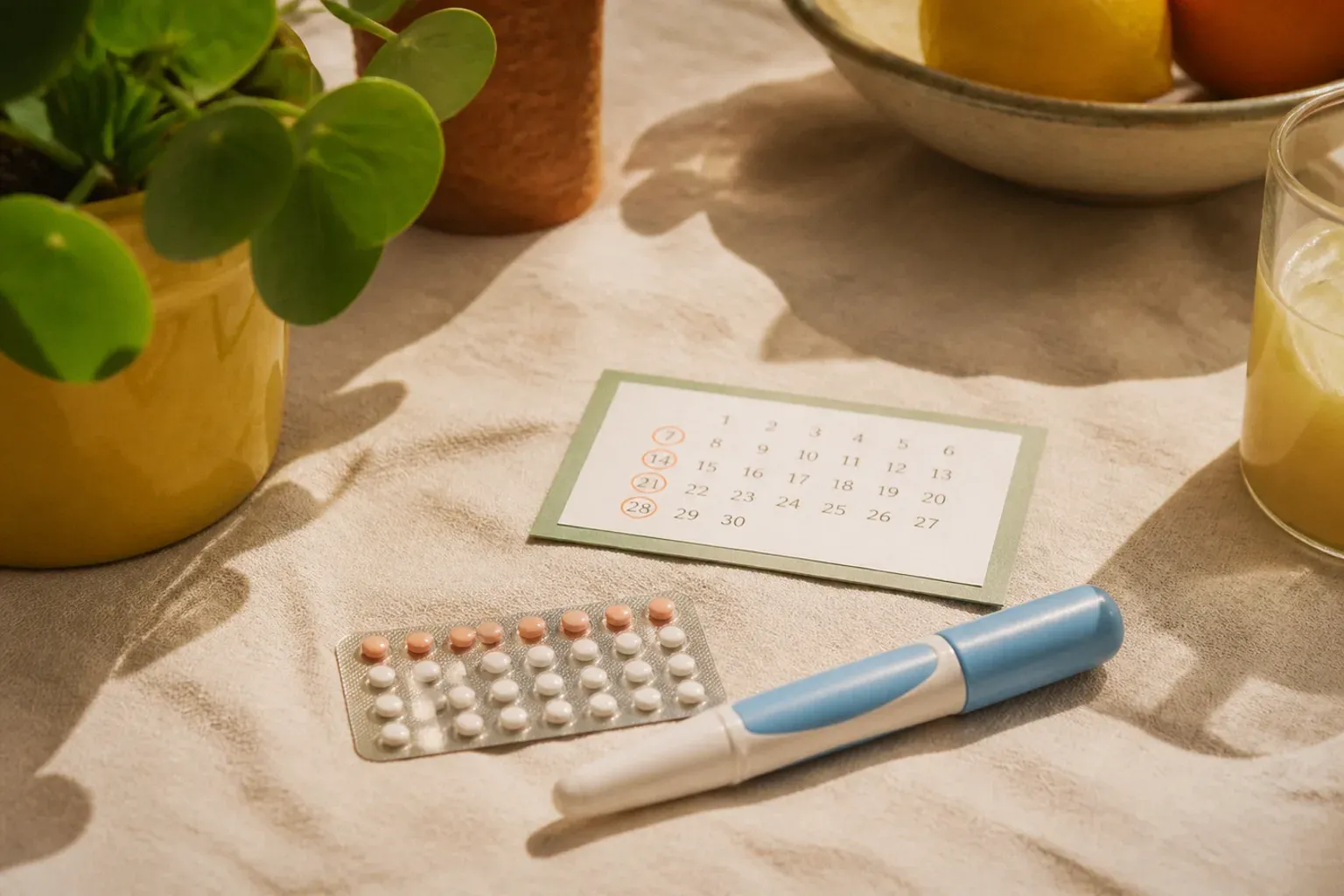
Birth control on a GLP-1 microdose is mostly a question about one drug and one kind of contraception. Tirzepatide can lower the hormone levels a birth control pill delivers, especially right after a dose change. Semaglutide does not appear to. Contraception that is not swallowed is not affected by either.
-59%
PEAK ETHINYL ESTRADIOL AFTER A FIRST 5 MG TIRZEPATIDE DOSE, PER THE ZEPBOUND LABEL
4 weeks
BACKUP CONTRACEPTION AFTER STARTING TIRZEPATIDE AND AFTER EACH DOSE INCREASE
1.11
ETHINYL ESTRADIOL EXPOSURE RATIO ON SEMAGLUTIDE 1.0 MG, MEANING NO DROP
Most interaction warnings on a GLP-1 label are about blood sugar. The contraception warning on tirzepatide is different. It exists because the drug slows the stomach, and a pill that sits in a slow stomach reaches the bloodstream later and at a lower peak.
This article draws on the current Zepbound and Wegovy prescribing information, two pharmacokinetic studies of liraglutide and semaglutide with combined pills, a 2024 pharmacist review of the interaction studies, two 2026 reviews, and the CDC's 2024 contraception guidance. One limit runs through all of it: no study has tested oral contraceptives with sub-label GLP-1 microdoses, and no study has counted pregnancies. The evidence is about hormone levels in the blood.
Key takeaways
- •The Zepbound label advises people on oral hormonal contraceptives to switch to a non-oral method or add a barrier method for 4 weeks after starting tirzepatide and for 4 weeks after each dose escalation.
- •After a single 5 mg tirzepatide dose, peak ethinyl estradiol fell 59% and total exposure fell 20%, with the hormone peak delayed by 2.5 to 4.5 hours.
- •Semaglutide did not reduce pill hormone exposure in its interaction study, and the Wegovy label carries no backup contraception instruction.
- •The patch, ring, injection, IUDs and implant bypass the stomach, and the Zepbound label says contraceptives not taken by mouth should not be affected.
- •No study has measured the pill interaction at microdoses, so the safest reading for a slow, step-by-step protocol is that every step-up restarts the 4-week caution.
Can a GLP-1 microdose make birth control pills less effective?
A GLP-1 microdose of tirzepatide could make a birth control pill less effective during dose changes, while semaglutide shows no such effect in testing. The Zepbound prescribing information states that tirzepatide may reduce the efficacy of oral hormonal contraceptives because it delays gastric emptying. The label adds that the delay is largest after the first dose and diminishes over time.
The mechanism matters for anyone using a low dose. The warning is not about tirzepatide breaking down pill hormones or changing liver enzymes. It is about timing in the gut. Our broader guide to GLP-1 medication interactions and oral absorption explains why a slower stomach matters more for some pills than others. A contraceptive pill is one of the pills where it matters, because it relies on steady hormone levels every day.
What does the tirzepatide label actually say about the pill?
The tirzepatide label says to switch to a non-oral contraceptive, or add a barrier method such as condoms, for 4 weeks after starting and for 4 weeks after every dose escalation. That instruction appears in the drug interactions section, in the section on people of reproductive potential and in the patient counselling section of the Zepbound prescribing information on DailyMed.
The numbers behind the warning come from a single study in the label's pharmacology section. Participants took a combined pill containing 0.035 mg ethinyl estradiol and 0.25 mg norgestimate alongside a single 5 mg dose of tirzepatide.
Combined pill hormones after one 5 mg tirzepatide dose: change in peak and total exposure (%)
Zepbound prescribing information, Clinical Pharmacology 12.3 (DailyMed, 2026). Norelgestromin is the active metabolite of norgestimate.
- Peak (Cmax)
- Total exposure (AUC)
Peak levels of ethinyl estradiol, norgestimate and norelgestromin fell by 59%, 66% and 55%. Total exposure over time fell by a smaller 20%, 21% and 23%, and the hormone peak arrived 2.5 to 4.5 hours late. The pattern fits a stomach that holds the pill longer. Most of the hormone still gets absorbed, but it arrives later and in a flatter curve.
Why is the risk highest after starting or raising the dose?
The risk is highest after a start or step-up because tirzepatide slows the stomach most at those moments, and the body adapts with continued dosing. The label shows this with acetaminophen, a standard marker of gastric emptying. After a first 5 mg dose, acetaminophen peak concentration dropped 55% and its peak came 1 hour later. At week 6 on 15 mg, there was no meaningful impact.
A 2024 review in the Journal of the American Pharmacists Association by Skelley and colleagues looked at 6 clinical trials. The one tirzepatide study showed significant drops in pill hormone levels, and the 5 studies of other GLP-1 drugs did not. The authors pointed to tirzepatide's rapid dose escalation and its larger effect on gastric emptying as the likely reasons.
The standard Zepbound schedule starts at 2.5 mg weekly for 4 weeks and rises in 2.5 mg steps after at least 4 weeks. Because each step-up opens a new 4-week backup window, on that schedule the windows run back to back for the entire climb to the maintenance dose. Backup is only off the table after a full 4 weeks at an unchanged dose.
Does semaglutide interfere with the birth control pill?
Semaglutide does not appear to interfere with the birth control pill. Kapitza and colleagues tested this in the Journal of Clinical Pharmacology in 2015. 43 postmenopausal women with type 2 diabetes took a combined pill with 0.03 mg ethinyl estradiol and 0.15 mg levonorgestrel for 8 days, first without semaglutide and again at a steady 1.0 mg weekly dose.
Pill hormone exposure with a GLP-1 versus without (ratio of AUC)
Jacobsen LV et al., J Clin Pharmacol 2011 (liraglutide, 21 women). Kapitza C et al., J Clin Pharmacol 2015 (semaglutide, 43 women). Dashed lines mark the 0.80 to 1.25 bioequivalence band.
- Ethinyl estradiol
- Levonorgestrel
Ethinyl estradiol exposure on semaglutide was 1.11 times the baseline level, inside the 0.80 to 1.25 equivalence band. Levonorgestrel exposure was 20% higher, a ratio of 1.20. Peak levels of both hormones also stayed within the band. In plain terms, semaglutide left the pill's hormones where they were or slightly higher, not lower. The current Wegovy prescribing information lists no clinically significant change in ethinyl estradiol or levonorgestrel.
Liraglutide showed the same picture in an earlier study of 21 postmenopausal women by Jacobsen and colleagues in the Journal of Clinical Pharmacology in 2011. Ethinyl estradiol exposure was 1.06 times baseline and levonorgestrel was 18% higher. For a side-by-side view of the two drugs at their lowest studied doses, see our comparison of microdose semaglutide vs tirzepatide.
How big is the tirzepatide effect compared with older GLP-1 drugs?
The tirzepatide effect on pill hormone peaks is several times larger than what older GLP-1 drugs showed. Liraglutide lowered the peak of ethinyl estradiol by 12% and levonorgestrel by 13%, with the peak arriving about 1.5 hours later. The first tirzepatide dose lowered the ethinyl estradiol peak by 59%.
Change in peak pill hormone levels (Cmax, %)
Tirzepatide: Zepbound prescribing information (progestin is norgestimate). Liraglutide: Jacobsen LV et al., J Clin Pharmacol 2011 (progestin is levonorgestrel). Different pills and study designs, so compare direction and size, not exact values.
- Ethinyl estradiol
- Progestin
A lower peak is not automatically a failed pill. Viana and colleagues made that point in a 2026 review in Maturitas, noting that the much smaller drop in total exposure to the active progestin metabolite shows a fall in peak concentration cannot be equated with reduced efficacy. The label takes the cautious route anyway, because the cost of being wrong is an unplanned pregnancy on a drug that the label says may cause fetal harm.
Does a microdose protocol change the backup rule?
No study answers this directly, and the backup rule was written for standard dosing. The only tirzepatide pill study used a 5 mg first dose, twice the labelled 2.5 mg starting dose and far above the amounts used in most microdose protocols. A smaller dose plausibly slows the stomach less, but that has not been measured.
Two features of low-dose protocols cut in opposite directions. Smaller doses should mean a smaller gastric emptying effect. Many microdose plans also rise in small, frequent steps, and the label ties its caution to every dose escalation, not to the size of the step. Read literally, a protocol that steps up every few weeks keeps the 4-week backup window open for the whole titration.
Compounded tirzepatide and research peptides such as retatrutide have no interaction studies with contraceptives at all. The practical reading, until data exist, is to treat each start and each step-up as a 4-week backup window, whatever the dose. Our guide on how to microdose tirzepatide for maintenance covers step-down protocols, where the dose falls rather than rises.
What happens if a GLP-1 makes me vomit after taking the pill?
Vomiting or severe diarrhea after taking the pill should be handled like a missed pill. The CDC's 2024 U.S. Selected Practice Recommendations for Contraceptive Use say pill effectiveness might theoretically be reduced by vomiting or severe diarrhea, and base their advice on the missed-pill recommendations. The CDC also notes that no study has measured this directly.
Vomiting and diarrhea in the SURMOUNT-1 trials, by tirzepatide dose (% of participants)
Zepbound prescribing information, adverse reactions table. Standard approved doses; microdoses were not tested.
- Vomiting
- Diarrhea
Vomiting affected 8%, 11% and 13% of people on 5, 10 and 15 mg, against 2% on placebo. Diarrhea affected 19% to 23%. This is a second, separate route to a weaker pill, and it applies to semaglutide as well as tirzepatide. Keeping the pill's missed-dose instructions handy and taking the pill at a time of day when nausea is lowest are simple safeguards. Our article on managing nausea on a GLP-1 microdose covers ways to keep the stomach settled.
Which birth control methods are not affected by GLP-1 drugs?
Any method that does not pass through the stomach is unaffected, according to the Zepbound label, which states that hormonal contraceptives not administered orally should not be affected. That includes the patch, the vaginal ring, the injection, hormonal and copper IUDs and the implant. Condoms and other barrier methods work independently of hormones.
Typical-use failure rate in the first year, by method (%)
CDC, Contraception and Birth Control Methods (2024). LNG IUD shown at the top of its 0.1-0.4% range. These are general population rates, not rates measured on GLP-1 medicines.
Even without a GLP-1 in the picture, the pill has a typical-use failure rate of 7% according to the CDC, the same as the patch and ring. The implant sits at 0.1% and the copper IUD at 0.8%. A 2026 clinical review by Dilbaz and Ateş in the European Journal of Contraception and Reproductive Health Care concluded that non-oral hormonal methods and long-acting reversible contraception may be more reliable options during GLP-1 treatment, particularly when stomach side effects are present.
What about progestin-only pills and menopausal hormone therapy?
Progestin-only pills are still oral hormonal contraceptives, so the Zepbound label's backup instruction covers them, even though the interaction study used a combined pill. The 2026 Maturitas review warns that results from one contraceptive formulation cannot be automatically applied to structurally different hormones.
The same review flagged a gap for women in midlife. Many take an oral progestogen to protect the womb lining during menopausal hormone therapy, and no equivalent data exist for those doses. The authors called an interaction biologically plausible but unproven, with any risk concentrated during initiation and dose escalation. Our article on GLP-1 microdosing in menopause covers hormone therapy alongside GLP-1 use in more depth.
Why does reliable contraception matter so much on a GLP-1?
Reliable contraception matters because GLP-1 medicines are not meant to be used in pregnancy. The Zepbound label says tirzepatide may cause fetal harm and should be stopped when pregnancy is recognized. The Wegovy label advises stopping semaglutide at least 2 months before a planned pregnancy because of its long half-life, and the Dilbaz review suggested a washout of about 8 weeks for both drugs.
Weight loss itself can shift fertility. Women with PCOS in particular may ovulate more regularly as weight and insulin resistance improve, which our article on GLP-1 microdosing, PCOS and fertility explores. Planning contraception before the first dose is easier than sorting it out after a missed period.
The label interaction is specific to tirzepatide, to the weeks after a start or step-up, and to pills taken by mouth. Vomiting or severe diarrhea on any GLP-1 is a separate reason to follow the missed-pill rules.
Frequently asked questions
Does tirzepatide make birth control pills less effective?
Tirzepatide can lower the amount of pill hormone that reaches the blood, mostly in the first weeks. In the study behind the Zepbound label, a single 5 mg dose cut peak ethinyl estradiol by 59% and total exposure by 20%. No study has measured pregnancy rates, but the label treats the risk as real and asks for backup contraception.
How long do I need backup birth control on tirzepatide?
The Zepbound label says to use a non-oral method or add a barrier method for 4 weeks after starting and for 4 weeks after each dose escalation. On a standard schedule, where the dose rises every 4 weeks, those windows sit back to back for the whole climb. Once the dose stays the same for 4 weeks, the label instruction no longer applies.
Does semaglutide affect the birth control pill?
Semaglutide did not reduce pill hormone levels in its interaction study. Kapitza and colleagues found ethinyl estradiol exposure 1.11 times and levonorgestrel exposure 1.20 times the levels seen without semaglutide, both at or above baseline. The Wegovy label lists no clinically significant change and carries no backup instruction.
Does a GLP-1 microdose still interfere with the pill?
Nobody has measured it. The only tirzepatide study used a 5 mg first dose, which is above the 2.5 mg starting dose and well above typical microdose amounts. A smaller dose plausibly slows the stomach less, but the label rule is tied to dose increases, so frequent small step-ups would each fall under the same 4-week caution.
Are the patch, ring, IUD or implant affected by tirzepatide?
No. The Zepbound label states that hormonal contraceptives not taken by mouth should not be affected, because the interaction works through slower stomach emptying. That covers the patch, the vaginal ring, the injection, hormonal and copper IUDs and the implant.
What if I vomit after taking my pill on a GLP-1?
Treat it like a missed pill. The CDC's 2024 contraception guidance says vomiting or severe diarrhea could reduce pill effectiveness and bases its advice on the missed-pill rules. Vomiting was reported by 8% to 13% of people on tirzepatide in the SURMOUNT-1 trials, so it is worth knowing the steps in advance.
Does tirzepatide affect hormone therapy for menopause?
It has not been studied. A 2026 review in Maturitas called an effect on oral progestogens used in menopausal hormone therapy biologically plausible but unproven. Anyone using an oral progestogen to protect the womb lining should raise this with their prescriber, especially around dose changes.
How long before trying to get pregnant should a GLP-1 be stopped?
The Wegovy label advises stopping at least 2 months before a planned pregnancy because semaglutide has a long half-life. A 2026 review suggested about 8 weeks for both semaglutide and tirzepatide. The Zepbound label says the drug may cause fetal harm and should be stopped when pregnancy is recognized.
Clinical references
- Eli Lilly and Company. ZEPBOUND (tirzepatide) injection, prescribing information. DailyMed. 2026. dailymed.nlm.nih.gov
- Novo Nordisk. WEGOVY (semaglutide) injection and tablet, prescribing information. DailyMed. 2026. dailymed.nlm.nih.gov
- Kapitza C, Nosek L, Jensen L, et al. Semaglutide, a once-weekly human GLP-1 analog, does not reduce the bioavailability of the combined oral contraceptive, ethinylestradiol/levonorgestrel. Journal of Clinical Pharmacology. 2015. doi:10.1002/jcph.443
- Jacobsen LV, Vouis J, Hindsberger C, et al. Treatment with liraglutide, a once-daily GLP-1 analog, does not reduce the bioavailability of ethinyl estradiol/levonorgestrel taken as an oral combination contraceptive drug. Journal of Clinical Pharmacology. 2011. doi:10.1177/0091270010389471
- Skelley JW, Swearengin K, York AL, et al. The impact of tirzepatide and glucagon-like peptide 1 receptor agonists on oral hormonal contraception. Journal of the American Pharmacists Association. 2024. doi:10.1016/j.japh.2023.10.037
- Viana DPDC, Invitti AL, Jacobsen L, et al. Tirzepatide and oral progestogens: A hypothesis-generating review of a biologically plausible pharmacokinetic interaction in gynaecologic disease control and menopausal hormone therapy. Maturitas. 2026. doi:10.1016/j.maturitas.2026.109116
- Dilbaz B, Ateş Ç. The effects of glucagon-like peptide-1 receptor agonists on fertility, contraception, and pregnancy: clinical perspectives. European Journal of Contraception and Reproductive Health Care. 2026. doi:10.1080/13625187.2026.2644895
- Curtis KM, Nguyen AT, Tepper NK, et al. U.S. Selected Practice Recommendations for Contraceptive Use, 2024. MMWR Recommendations and Reports. 2024. doi:10.15585/mmwr.rr7303a1
- Centers for Disease Control and Prevention. Contraception and Birth Control Methods. 2024. cdc.gov
Medical disclaimer. This article is for general educational and informational purposes only. It is not medical advice and not a substitute for the clinician or pharmacist responsible for your care. Sub-label "microdose" regimens of GLP-1 medicines have not been tested in clinical trials, and no study has measured the contraceptive interaction at microdoses. Charts show values reported in the cited label and studies. Do not stop or change contraception without talking to a prescriber, and take a pregnancy test and seek advice if a period is missed while on a GLP-1 medicine.